
Author: Mark Middendorp

  • PhotoAudit+ Launches Preferred Partner Program to Modernize Visual Field Documentation Across Key Industries.

    PhotoAudit+ Launches Preferred Partner Program to Modernize Visual Field Documentation Across Key Industries.

    SaaS innovator invites select organizations to shape the future of field operations—offering 60 days of free, full-platform access with dedicated implementation support.

    WASHINGTON, May 4, 2026 /PRNewswire/ — PhotoAudit+, announced today the launch of its Preferred Partner Program—a first-of-its-kind initiative inviting select organizations to co-develop the future of visual field documentation. Through the program, Preferred Partners receive 60 days of complimentary, full-platform access along with customized implementation, dedicated support, and direct influence over the company’s product roadmap.

    The launch comes at a pivotal moment for industries that depend on field crews to deliver results. From telecom and utilities to EV infrastructure, construction, and property management, organizations of all kinds are under growing pressure to verify field work faster, reduce errors, and close out projects without the friction of manual documentation. PhotoAudit+ was purpose-built to solve exactly that problem.

    “We built PhotoAudit+ because field teams deserve tools that actually work the way they were intended to —on the ground, in the moment, with no friction,” said Jennifer Barenholtz, COO of PhotoAudit+. “The Preferred Partner Program is our way of ensuring that the organizations who depend most on accurate field documentation have a hand in shaping the platform. This isn’t just early access—it’s a seat at the table.”

    A Platform Built for the Field—and the Bottom Line

    At its core, PhotoAudit+ is a photo validation tool designed for field-based teams. The platform streamlines field operations by enabling companies to verify and validate the work of field crews in real time, creating an ironclad audit trail complete with geo-location, timestamps, and dashboard-based reporting. The result is faster project closeouts and a measurable impact on the bottom line.

    Powered by founder-designed technology, the platform bridges home office and remote team communication through an intuitive dashboard that surfaces current intelligence, active tasks, and real-time project status in a single view.  The AI-powered checklist tool functions as a structured guide for the team, helping to outline exactly what photo evidence is required, so every deliverable is documented.

    PhotoAudit+ was designed for zero-friction field adoption. The platform integrates with any API system, requires no specialized hardware, and can be deployed—hyper locally or globally—with teams up and running in as little as 15 to 30 minutes using pre-built workflows.

    Flexible, Scalable, and Built to Grow with You

    PhotoAudit+ operates on a subscription pricing model that is flexible enough to grow alongside its clients. Throughout every customer subscription, organizations can shift projects, teams, or locations without disruption. The platform offers rapid configurations, real-time access, and remote support so that changes in scope or geography never slow operations down. AI-based integrations further increase productivity and accelerate solution deployment across client environments.

    What Preferred Partners Receive

    The Preferred Partner Program is structured to deliver immediate value with no financial risk. Qualifying organizations receive:

    • 60 days of full platform access for both field and office teams, including mobile app access for on-site workers and web portal access for reviewers and management—with no upfront cost or implementation fees during the pilot.
    • Customized implementation, including checklists tailored to specific job requirements, workflows configured to match existing team processes, and custom onboarding sessions.
    • Dedicated support, including regular check-ins during onboarding and rollout, live technical support as needed, and priority response to questions throughout the engagement.

    “Preferred Partners don’t just get early access—they get a solution built around their real needs,” Barenholtz added. “Every organization that joins this program becomes part of how we build. Their challenges become our roadmap, and their wins validate why we do this work.”

    The PhotoAudit+ Preferred Partner Program is open to a limited number of select organizations across the company’s primary verticals. Interested parties are encouraged to reach out directly to Mark Middendorp, Director of Sales at  [email protected] to  learn more and begin the onboarding process.

    About PhotoAudit+

    PhotoAudit+ is a venture-funded, global SaaS company headquartered in Florida, that provides a proprietary photo validation and field documentation platform for companies with field-based teams. Serving clients across telecom, utilities, EV infrastructure, construction, property management, and beyond, PhotoAudit+ enables organizations to verify field work, accelerate project closeouts, and maintain comprehensive audit trails through its proprietary technology. The platform supports hyperlocal to global deployments and is available via subscription pricing. For more information, visit www.photoauditplus.com.

  • Time To Adopt A Smarter Photo Auditing Platform?

    Time To Adopt A Smarter Photo Auditing Platform?

    A good photo auditing platform is no longer a ‘nice to have’.  Picture this: it’s 9pm and your major customer is on the phone.

    They’re claiming the fibre cabinet wasn’t installed to spec and are withholding payment until you can prove otherwise. You know the field crew took photos. You remember them mentioning it in the handover. But now you’re digging through a WhatsApp thread, downloading images with names like IMG_4837.jpg. No location data. No clear timestamp. No way to show which cabinet, which site, or which engineer touched it.

    In telecoms, just like many other site-based industries, site photos aren’t “nice to have” – they’re evidence. They prove the cabinet was installed correctly and the job was completed on time. They’re what stands between a smooth sign-off and weeks of back-and-forth.

    Yet despite how critical they are, site photos are still scattered across phones, messages, and folders, making the proof you need hardest to find when it matters most.

    The smartest teams aren’t taking more photos – they’re taking the right ones. This is where PhotoAudit+ fundamentally changes the process.

    The Problem of Disorganised Photo Records

    At present, most site teams rely on personal devices to capture photos. While this is convenient in the moment, it creates problems almost immediately:

    • Photos are stored in personal phone galleries alongside private images.
    • Images are sent from multiple sources via email, messaging apps, or file transfers.
    • Files arrive out of order, without consistent naming or context.
    • Metadata is often lost or stripped during sharing.
    • There is no single ‘source of truth’ for photo evidence.

    Photos may be missing, duplicated, mislabelled, or impossible to place accurately within a project timeline. Managers are forced to reconstruct events after the fact, relying on memory, guesswork, and time-consuming manual sorting.

    The result is a closeout report that takes far longer than it should to produce, and may still [CF1.1]lack the clarity, reliability, and auditability stakeholders expect.

    A Single Platform for Reliable Photo Evidence

    PhotoAudit+ addresses this problem by introducing structure at the point of capture rather than attempting to impose it later. Photos [CF2.1]are still taken using personal mobile devices, preserving convenience and adoption, but they are captured through the PhotoAudit+ dedicated app that uploads images directly into the centralised PhotoAudit+ platform instead of storing them in personal galleries.

    The images are stored securely, organised by project, location, date, and activity, and made immediately available for review. From the moment a photo is taken, it becomes vital information about your project. It is automatically associated with the correct project, location, asset, or activity and retains its original metadata and timestamp.

    When photos are captured and stored in this structured environment, they form a continuous and sequential representation of site conditions over time. This enables teams to review progress as it happens and identify omissions or issues early, rather than discovering them during closeout or audit phases.

    At the end of the project there is no need to chase people for missing files, and no risk of photos being forgotten on a device or lost in a message thread. From day one, the project builds a structured, chronological visual record.

    Better Closeout Reports

    One of the biggest benefits of using PhotoAudit+ is that it removes the manual effort required to make sense of scattered photos.

    Instead of receiving images weeks or months later and trying to reconstruct what happened, managers can view progress and provide feedback or approval in real time. Photos are already sequenced, labelled, and linked to specific site activities, creating instant visibility and dramatically reducing the effort required to prepare reports. PhotoAudit+ acts as a living archive, allowing managers to quickly compile a comprehensive, reliable closeout report without needing to sort, rename, or reorganise hundreds of files.

    This is a key benefit of having images stored in one system, organised consistently, captured in sequence and tied to specific locations or tasks. The resulting closeout report is more accurate, more defensible, and far easier to review. This level of clarity is especially valuable for compliance, audits, handovers and dispute resolution. And along the way, you benefit from significant time savings and efficiencies with having a streamlined system for photo capture and management.

    Next Steps

    In an industry where delays, disputes, and missed evidence cost real money, the smartest teams aren’t taking more photos. They’re capturing the right ones, in the right way, from day one. That’s what PhotoAudit+ enables.

    If you already rely on photos as evidence, it’s time to manage them like evidence too. To experience a more streamlined way of specifying, capturing and organising images, sign up to our Early Adopter Programme, giving you all the benefits of PhotoAudit+ for free for an initial period. Get in touch.

  • Why 5G Buildouts Changed What ‘Complete Documentation’ Means

    Why 5G Buildouts Changed What ‘Complete Documentation’ Means

    For decades, ‘complete documentation’ in wireless infrastructure followed a familiar pattern. A standard set of photos, measurements, annotated drawings, and a technician’s experience were usually enough to satisfy stakeholders. That approach worked because network architecture was comparatively simple. 5G fundamentally changed that equation.

    What we are seeing across the industry today is a step-change in infrastructure complexity. As a result, documentation has become a core operational requirement. The definition of ‘complete’ has expanded, and legacy documentation methods are increasingly unable to keep up.

    Equipment Complexity Demands More Detail

    At the macro site level, 5G dramatically increased the physical and technical complexity of deployments. Towers that once hosted a relatively straightforward configuration are now much more complex.

    This directly impacts documentation expectations. Stakeholders now require detailed evidence of antenna types, serial numbers, cable routing, and precise mounting configurations. Structural engineers need clear visual confirmation of what is on site. Safety teams require documentation that demonstrates proper adherence to load calculations and installation specifications.

    A single front-facing photo is no longer sufficient. 5G documentation requires multiple angles, close-ups, wide shots, and contextual views that show how components interact with each other and with the structure itself. Missing one angle or mislabeling one component can delay approvals, trigger rework, or expose teams to compliance risk.

    Volume Turns Small Gaps Into Big Problems

    The second major shift is volume. 5G has driven both widespread modification programs and large-scale new builds.

    At this scale, documentation gaps compound quickly. A missing photo on one site may be a nuisance. The same omission repeated across a few hundred sites becomes a systemic problem that slows invoicing, acceptance, and network activation.

    5G demands consistency at scale. That means every site needs the same level of completeness, captured in the same way, aligned to the same requirements.

    Higher Standards Drive Compliance Pressure

    The third shift is compliance. Requirements have tightened and compliance documentation is under greater scrutiny.

    Stakeholders now expect documentation that does more than prove work was completed. It must demonstrate that work meets specific technical specifications, safety standards, and regulatory conditions. That often means supporting measurements, precise visual evidence, and traceability back to approved designs.

    Why Legacy Documentation Methods Break Down

    For years, the industry relied on experience-driven processes: seasoned technicians knowing what to photograph, supervisors reviewing photos after the team had left the site, and teams filling in gaps with explanations or follow-up calls.

    Unfortunately, mental checklists are invisible and unverifiable. Example photos don’t scale across diverse site conditions. Verbal instructions are interpreted differently by every crew. And none of these methods enforce completeness in the moment when crews are on site and issues can still be corrected.

    What 5G has made clear is that documentation must be treated as a system. It needs to guide field teams on exactly what to capture, ensure the right angles and details are collected, and provide confidence that requirements are met before anyone leaves the site.

    Systematic Documentation for Complex Infrastructure

    The solution requires a fundamental shift from ad-hoc documentation to systematic capture. Instead of relying on memory, interpretation, or rework, teams need technology that guides them through every requirement while they’re still on site.

    This is the context in which PhotoAudit+ was built.

    PhotoAudit+ is purpose-built for today’s network deployment standards. Our AI-powered checklists guide technicians through every required angle and detail for 5G deployments, ensuring nothing is missed. The platform prompts for specific shots – antenna serial numbers, cable routing paths, ground kit installations – and verifies completeness before teams leave the site.

    Rather than hoping crews remember everything or discovering gaps during desk review, PhotoAudit+ ensures consistency across sites and crews from the first photo to project closeout.

    Join the Early Adopter Program

    We are currently working with early adopters in the tower industry who receive full access to the platform at no cost while helping us refine features for real-world 5G deployment scenarios. Early adopters also receive priority technical support and exclusive input on our feature roadmap.

    If your team is facing the growing complexity, volume, and compliance demands of modern network builds, we would welcome you into our early adopter program. You’ll not only solve immediate documentation challenges but help shape the platform that will become the industry standard.

    Please get in touch to book a demo or discuss being part of our early adopter program.


  • How Photo Auditing Prevents Costly Problems

    How Photo Auditing Prevents Costly Problems

    The nature of EV charger installation means work happens across multiple sites with tight schedules and technical complexity. Because of this, clear communication aided by photo auditing is critical.

    Misunderstandings between office-based managers and field teams can lead to costly mistakes, delays, and rework that drains both time and budget. In many cases, these misunderstandings don’t come to light until it’s too late, when the job is already complete, an inspection has failed, or a client flags an issue.

    Fortunately, new technology is changing that. PhotoAudit+ helps companies identify and resolve issues before they become expensive problems. By combining pre-agreed checklists, real-time visual documentation, and seamless communication tools, PhotoAudit+ brings new levels of clarity and accountability to on-site work, making it easier to catch problems early, and even prevent them altogether.

    The Power of Pre-Agreed Checklists

    A major source of confusion on installation jobs stems from different expectations about what needs to be done, and how it should be documented. Field teams may interpret requirements differently than managers or clients, leading to inconsistencies in quality, missed steps, or incomplete documentation.

    That’s why our platform puts pre-agreed checklists at the heart of the process. These checklists serve as a shared reference point for everyone involved, from project managers and supervisors to the engineers on the ground. Before a team even steps foot on-site, they know exactly what’s expected: what work needs to be performed, what photos must be taken for visual assurance, and what standards need to be met.

    This shared understanding minimizes guesswork and reduces the chance of someone skipping a step or overlooking a critical detail. It also empowers field workers by giving them clear, structured guidance, and ensures that managers don’t have to rely on assumptions or follow-up calls to confirm that things were done correctly.

    Real-Time Visual Evidence

    Even the most detailed written reports can leave room for interpretation. That’s why real-time, time and location stamped visual evidence is the most powerful tool for clear, objective communication. When a photo shows a trench is the right depth, a charger is mounted correctly, or a connection has been completed safely, there’s no debate.

    PhotoAudit+ makes capturing and sharing this kind of evidence easy. As engineers complete tasks, they take photos directly through the mobile app, following the prompts provided by the checklist. These images are automatically tagged with time, date, and GPS location, so there’s never any question about when and where they were taken.

    Most importantly, these photos are available to office-based teams in real time. Project managers don’t have to wait for end-of-day emails or try to piece together updates and photos from different sources. Instead, they can see progress as it happens, review photos on the spot, and flag any concerns immediately. If something looks off, they can intervene before the work continues, saving hours, or even days, of potential rework.

    Enhancing Collaboration Across Teams

    In EV infrastructure projects, smooth collaboration between field and office teams is essential. But too often, communication breaks down because the two groups work in silos. Office-based managers rely on paperwork or secondhand updates, while field staff operate under pressure to complete tasks quickly, often with limited visibility into project-wide expectations.

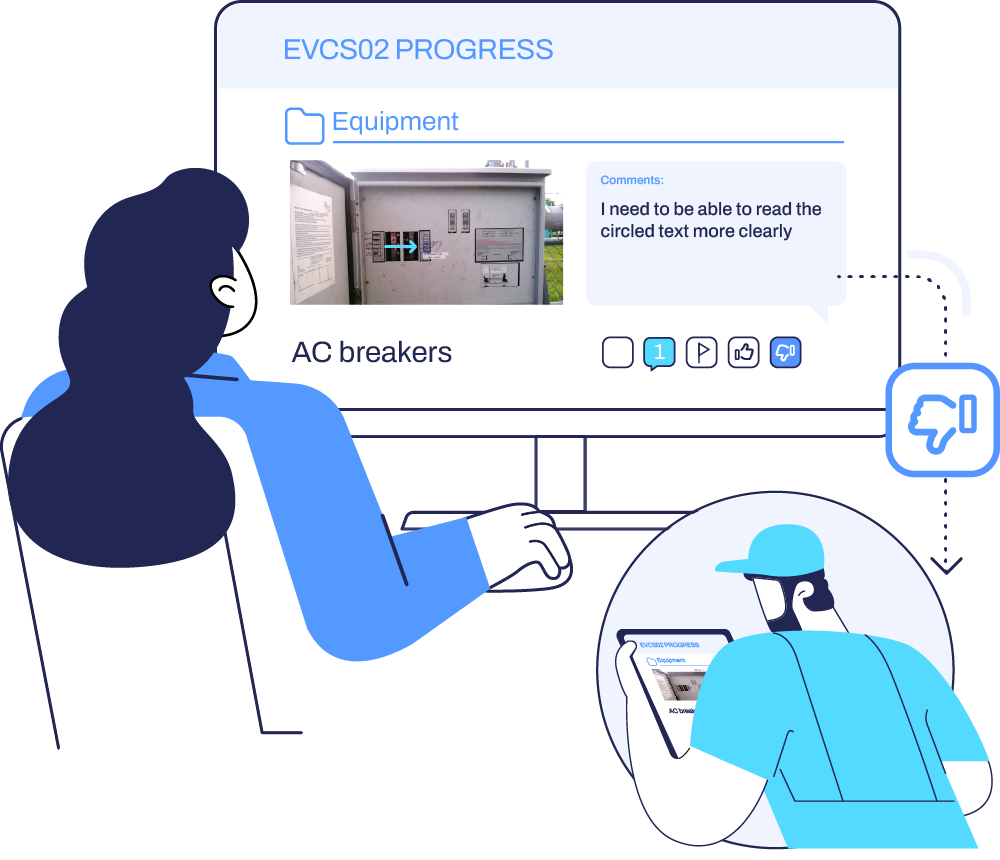
    PhotoAudit+ bridges this gap that everyone is aligned. Managers can review visual updates from anywhere, approve completed steps, add annotations to images, and provide instant feedback. Field teams, in turn, get direct, visual confirmation of what’s been approved, what needs attention, and what’s still outstanding.

    This two-way flow of communication ensures that issues are resolved faster, and misunderstandings are avoided altogether.

    Preventing Mistakes Before They Become Rework

    One of the biggest benefits of PhotoAudit+ lies in its ability to prevent problems before they become expensive. Instead of relying on post-project inspections or corrective action, companies can use real-time photo auditing to spot and fix small issues early, before they turn into major setbacks.

    This proactive approach not only reduces rework and saves money; it also improves quality across the board. When teams know their work is being reviewed in real time they’re more likely to follow procedures carefully and take ownership of their work.

    A Smarter, Simpler Way to Communicate

    At its core, PhotoAudit+ is about simplifying communication and making expectations crystal clear. It replaces vague instructions and delayed updates with a structured, visual workflow that keeps everyone informed and accountable, offering a smarter, safer way to work. It gives managers peace of mind, empowers field teams, and ensures that every job is done right the first time.

    In a sector where the difference between profit and loss often comes down to the smallest details. With photo auditing, you can catch those details before they cause problems, and keep your projects running smoothly from start to finish.

    To find out more or to arrange a demo of PhotoAudit+, please get in touch.


  • The Future of EV Installations is Visual – Are You Ready?

    The Future of EV Installations is Visual – Are You Ready?

    The move towards electric vehicles is accelerating across the globe.

    This rapid expansion presents both an opportunity and a challenge for installers and service providers. To meet increasing expectations for speed, accuracy, and accountability, the industry must evolve. That evolution is visual.

    Gone are the days when handwritten notes and disorganized folders of job-site photos could suffice for documenting charger installations. Today, clients demand more. The future of EV installations lies in structured visual documentation – systems that not only capture what happened on-site, but verify, organize, and communicate it in real-time. PhotoAudit+ represents this next generation of installation management and sets the benchmark for industry best practice.

    At the core of our approach is the concept of customized visual workflows. Each EV installation site is unique, with varying conditions, compliance requirements, and stakeholder expectations.

    Recognizing this, PhotoAudit+ allows teams to work with either standardized or fully tailored checklists. You can use the manufacturer’s installation manual, adapt it to your site location or internal standards, or create a checklist entirely from scratch. This ensures that every project begins with clarity, consistency, and structure.

    Once on site, the installer is guided through each step of the documentation process. The platform prompts users to take pre-specified photos according to the customized checklist. This not only ensures that all critical aspects of the installation are captured, but also reduces the chances of errors or omissions. By following a step-by-step process, the installer knows exactly what needs to be recorded, simplifying the documentation process and improving overall job quality.

    In addition to these required images, PhotoAudit+ also offers flexibility for real-world scenarios. Installers can upload additional photos when unexpected issues or variations arise. Whether it’s documenting an obstruction, capturing a last-minute change, or showing site conditions that weren’t initially anticipated, these additional images are automatically integrated into the job’s visual record. Everything is kept organized and accessible, so nothing is lost.

    What sets PhotoAudit+ apart is its ability to verify the authenticity of every image. Each photo captured through the app is automatically tagged with precise time, date, and GPS location metadata. This means there’s no need for manual labelling or sorting back at the office. It becomes instantly clear where and when the work was completed. This built-in verification is invaluable for internal quality control, client transparency, and audit readiness. When disputes arise or inspections are required, the evidence is already in place.

    Equally important is how quickly field data becomes available to project managers and office teams. As photos are taken and uploaded, they appear in real-time for review. Supervisors can immediately access the visual record, approve completed steps, flag potential issues, or reject incorrect work, all with a single click. This responsiveness significantly reduces the delays often caused by back-and-forth communication, allowing for faster job completion and more efficient resource use.

    To further enhance communication and clarity, the platform includes tools for text and visual annotation. Users can add notes directly to images or draw attention to specific areas using visual markup tools such as arrows, highlights, or circles. This is particularly useful for highlighting problems or providing follow-up instructions, ensuring that field teams can quickly understand and act on feedback without misinterpretation.

    It’s this seamless communication between field and office-based teams that makes all the difference. With PhotoAudit+, there’s no need to send large image files via email or manage separate cloud storage folders. Instead, the entire workflow of photos, checklists, annotations, and approvals is stored in one place. This improves collaboration, ensures consistent quality control, and reduces the risk of lost or misplaced documentation.

    The impact of adopting this visual-first approach is significant. As EV infrastructure continues to scale, so does the complexity of managing installations across multiple sites, teams, and jurisdictions. PhotoAudit+ addresses these challenges head-on by delivering a smarter, more streamlined way to handle installations. It empowers organizations to scale operations without compromising quality or oversight.

    By embracing structured visual documentation, you demonstrate a commitment to transparency, accountability, and excellence. You make it easier to onboard new technicians, standardize processes across regions, and ensure that every installation meets your standards.

    The future of EV installations is undeniably visual. There’s no need to continue with outdated methods. With PhotoAudit+, you can take control of your installations, achieve efficiencies and ensure consistent quality.

    Let us help you bring the future of EV installations into focus – one verified photo at a time. Get in touch to find out more or to arrange a demo.


  • Enhancing EV Infrastructure Deployment with Photo Auditing

    Enhancing EV Infrastructure Deployment with Photo Auditing

    One of the most powerful tools available to EV installation teams today is photographic auditing technology.

    Solutions like PhotoAudit+ are becoming essential not just for ensuring quality and compliance but for streamlining project delivery and reducing operational risk. As a visual verification platform purpose-built for EV infrastructure deployment, PhotoAudit+ captures, organizes, and validates installation workflows at scale – transforming how field teams and project managers maintain control over fast-moving, geographically dispersed projects.

    The Role of Photographic Validation in EV Charger Installations

    The stakes are high in EV infrastructure projects. A single charger that’s offline due to installation errors or delayed inspections can result in lost revenue, contract disputes, or reputational damage.

    PhotoAudit+ introduces a proactive solution: progressive photo validation that integrates directly into field workflows. Each step of the installation – from trenching and conduit runs to electrical connections and signage – is visually documented in real time. This allows project managers to verify work instantly, ensure compliance, and move confidently toward commissioning.

    Key benefits include:

    • Regulatory compliance
      High-resolution imagery acts as visual proof that site works meets design specifications, and regulatory guidelines. This is especially critical when working across varied local jurisdictions and environmental conditions.
    • Quality Assurance
      Photographic verification visually confirms that all components are correctly installed and meet required standards. Teams can identify and correct issues early, ensuring consistent workmanship. Furthermore, visual evidence creates a reliable reference for future maintenance.
    • Audit-ready documentation for federal grants
      With public dollars funding many deployments, rigorous documentation is essential. PhotoAudit+ creates a centralized, time-stamped visual archive that supports grant disbursements, regulatory inspections, and end-of-project reporting. Images are organized and annotated to show how each aspect of the install each fits into the overall project. It includes the time, date and location of each shot and photos can be exported in a range of formats, or integrated with pre-existing workflows.
    • Future-proofing for maintenance & service – installation photos serve as a durable record of what’s beneath the surface – such as conduit routing or equipment placement – helping teams troubleshoot issues without guesswork.
    • Transparency & stakeholder trust – sharing visual updates with partners enhances transparency and build credibility, especially on public infrastructure projects.

    Standardized Image Capture for Workflow Integrity

    Consistency in image capture is vital for ensuring data integrity. PhotoAudit+ allows firms to deploy standardized image protocols across all projects and teams. Using pre-built, customizable checklists, project managers define exactly what images are required – by location, angle, and stage. Field personnel must complete these requirements before proceeding to the next milestone, creating a built-in verification gate at every phase. PhotoAudit+ features an AI-enabled checklist assistant to help create tailored, task specific lists of photos.

    Each image is automatically geo-tagged, time-stamped, and uploaded to the cloud, ensuring traceability and eliminating disputes about what happened and when. This structured documentation approach reduces costly rework, accelerates approval cycles, and supports real-time collaboration across stakeholders.

    Furthermore, the platform facilitates integration with existing project management systems, linking images to work orders, quality control checklists, and commissioning reports. This creates a fully traceable digital thread from start to finish.

    Lessons From Other Sectors: Telecoms and Construction

    Photographic validation has already demonstrated its value in other industries, notably telecoms and construction, where field verification and compliance are equally critical.

    In telecom deployments, for example, standardized photo audits are used to validate antenna positioning, cabling routes, and pole integrity – minimizing tower climbs and post-installation field visits, preserving the profitability of a job. In construction, photo documentation of foundation work, utility trenching, and final build conditions supports inspections, mitigates liability, and improves coordination among trades.

    EV infrastructure can borrow from these proven practices. Whether it’s ensuring that bollards are spaced correctly or that conduit is buried to spec, visual records allow engineering teams to ‘see’ what was done, even months later.

    Preparing for Scale with AI-Powered Validation

    As the EV industry scales, engineering firms are increasingly turning to AI-enhanced auditing tools to automate quality control. PhotoAudit+ is currently developing features that use computer vision to flag anomalies in uploaded images, such as incorrect equipment placement, missing components, or safety hazards.

    PhotoAudit+ already includes a tool to make it easy to create a media set. In future iterations, the platform will automatically generate image checklists tailored to project types, permitting conditions, and utility requirements.

    AI validation of each image, ensuring each photo is reviewed and potential issues flagged, is not far off. This evolution from manual verification to AI-assisted validation will help maintain consistency across hundreds of sites while allowing project teams to focus on higher-order engineering tasks.

    Seamless Adoption & Minimal Overhead

    Despite its advanced capabilities, PhotoAudit+ is designed for quick deployment and ease of use. The app requires only standard smartphones or tablets. Field teams can be onboarded in minutes, with intuitive prompts guiding them through photo capture and upload.

    Project managers use a web-based portal to configure image requirements, monitor projects, and review submissions in real time. Cloud storage ensures secure, organized access for all stakeholders, with role-based controls and encryption to protect sensitive data.

    Please contact us to find out more or book a tailored demo.

  • How Photo Validation Prevents Wasted Time & Money

    How Photo Validation Prevents Wasted Time & Money

    As the EV market expands, so does the demand for fast, reliable, and cost-efficient installation of charging infrastructure. But with this rapid growth comes increasing pressure to deliver projects on time, on budget, and to the highest standard. For companies installing EV chargers, the cost of revisiting work – fixing mistakes or redoing tasks – is a frustration and a drain on profitability.

    Revisiting work is a well-known problem, with additional expenses relating to reinstallation, new materials, and schedule disruptions. EV charger installation projects are not immune to these challenges. In fact, with evolving technology, and a growing need for standardised documentation, the risks are particularly high. The good news? One simple tool can help installation companies cut costs while improving quality: PhotoAudit+.

    Why Revisiting Work Happens – and Why It’s So Expensive

    Before exploring how photo validation works, it’s important to understand the root causes of rework. The most common factors include unclear documentation, poor communication, misaligned expectations between teams, and lack of oversight. In projects where multiple stakeholders are involved, even minor misunderstandings can spiral into major corrections.

    In EV infrastructure projects, this might mean replacing a charger mounted at the wrong height, digging up a trench that wasn’t deep enough, or re-routing cabling that failed inspection. Every one of these corrections costs time, money, and reputation.

    What makes these problems worse is that they’re often only identified after the fact – when the team is off-site, the materials are buried, or the client notices an issue. At that point, rework becomes inevitable.

    How Photo Validation Reduces The Need To Revisit Work

    Photo validation with PhotoAudit+ offers a practical and powerful solution. At its core, PhotoAudit+ enables the capturing of visual evidence of key project stages in real time, providing a clear, date and location-stamped record of progress, quality, and compliance. But more than that, PhotoAudit+ is a comprehensive quality control and collaboration tool.

    For EV charger installers, this means that field technicians can document every step of the process, from the condition of the site before work begins to the final setup of the charger. Each image is automatically tagged with time, date, and GPS location, ensuring a verifiable digital trail of who did what, when, and where.

    This has several immediate benefits. First, it provides evidence of compliance with electrical standards and safety regulations. When inspections occur or disputes arise, there’s no ambiguity. Second, it enables early identification of defects or inconsistencies. Because progress is documented step-by-step, problems are spotted sooner, often before they require costly remediation.

    Real-Time Collaboration Without Site Visits

    Many EV installation projects involve geographically dispersed teams and external partners. Supervisors, project managers, and even clients may not be on-site when crucial decisions are made. Without visibility, misunderstandings are common, and mistakes are more likely to slip through.

    With PhotoAudit+, all stakeholders can access project images in real-time from any location. This remote visibility supports faster decision-making and fewer delays. For example, if a technician flags an obstruction during a site visit, a manager can assess the issue and provide instructions immediately, without needing to travel.

    This real-time communication and collaboration reduce the likelihood of duplicated effort, ensure everyone is aligned, and speed up approvals. It also fosters greater accountability, as every photo is tied to a specific user and timestamp, making responsibilities clear.

    Cutting Costs Through Improved Documentation

    In addition to improving quality and collaboration, photo validation delivers direct financial benefits, particularly by reducing the cost of having to revisit work. When documentation is consistent and verifiable, disputes are rare. Subcontractors are less likely to make errors, and any issues are quickly resolved before they require reinstallation.

    Photo validation also supports faster payment cycles. Many EV charger installation contracts are milestone-based, requiring proof of completion before invoices can be submitted. Visual records serve as indisputable evidence that work is complete and up to standard. This can significantly accelerate invoicing, improve cash flow, and reduce administrative delays.

    Moreover, when clients can see photographic proof of progress, their confidence in the installation process increases, leading to fewer callbacks, complaints, and warranty claims.

    A Long-Term Investment in Quality

    While implementing a photo validation platform requires initial setup and training, the long-term return on investment is undeniable. When just one rework incident can cost thousands of pounds, a tool that prevents even a fraction of those mistakes pays for itself many times over.

    The future of EV installations is efficient, transparent, and visual. Is your business ready? Find out more or arrange a demo by visiting photoauditplus.com.

  • Unleash The Power Of Geo-tagged Photo Evidence

    Unleash The Power Of Geo-tagged Photo Evidence

    Imagine managing a construction site, EV charger installation or mobile phone tower deployment – from hundreds of miles away – and still knowing exactly what’s happening on (or above) the ground.

    Geo-tagged photos – images embedded with a precise location and timestamp data – are rapidly transforming how field-based industries operate.

    Whether it’s monitoring the utility installation for a new building, verifying the location of a roadside EV charger, or checking the placement of a mobile phone antenna, these images offer undeniable proof of what was done, where, and when.  The result?  Faster decision-making, greater accountability, and streamlined remote supervision.


    Applications Across Industries

    Construction Sites

    In construction, geo-tagged photos help track the progress of different project phases.  For site managers, this means they can monitor milestones, ensure that subcontractors are adhering to schedules, and quickly identify discrepancies between plans and execution.  It’s also a valuable resource for quality assurance and safety compliance.


    EV Charging Infrastructure

    As governments rapidly expand EV charging networks, geo-tagged photographic documentation ensures that installations meet regulatory standards and are correctly sited.  For instance, proof that a charging station was installed at the precise approved location and includes the required signage and safety clearances can be instantly verified from a distance.


    Mobile Phone Networks

    Deploying antennas and base stations requires careful site selection and installation, of course.  Geo-tagged imagery allows network operators to validate the positioning and integrity of equipment installations in urban and remote areas.  It ensures that assets are not only placed where they are planned but also aligned correctly and protected against environmental risk.

    Aiding Remote Supervision

    PhotoAudit+ brings a number of benefits to the remote supervision process.


    • Improved oversight & accountability

    Managers no longer have to rely solely on verbal updates, ambiguous documents or photographs after the fact. Geo-tagged photos provide indisputable evidence of who did what, when, and where. This enhances accountability among contractors and field teams, reducing the likelihood of incomplete or falsified work reports.


    • Remote quality control

    With access to geo-tagged photos in real-time, project managers can evaluate workmanship and detect issues early, without needing to visit the site. This is especially valuable for large-scale projects spread across regions or countries. For example, if a network technician installs an antenna on a building rooftop, the supervisor can instantly verify that it is properly mounted and aligned based on the photo’s metadata.


    • Streamlined communication

    Visual evidence eliminates ambiguity in reporting. A single image can convey more information, more easily than a paragraph of text, especially when discussing physical work. Geo-tagged photos allow teams across departments to understand site status instantly, even when located remotely.


    • Faster issue resolution

    When problems arise, being able to reference photographic evidence accelerates decision-making. Supervisors can spot inaccuracies or problems from real-time photographs which have to be reviewed before a project can proceed.  This means they can instruct a correction without the need to travel. This responsiveness saves time, reduces costs, and prevents project delays.


    • Regulatory compliance

    Many projects require evidence for inspections and audits. Geo-tagged images provide a defensible record that tasks were completed as required. This is particularly crucial in highly regulated industries, such as energy and telecommunications, where incorrect installations can result in penalties or safety risks.


    • Historical documentation & project archives

    Geo-tagged photographic records serve as valuable historical records for future maintenance, expansion, or dispute resolution. For instance, if a fault is identified in a charging station months after installation, reviewing geo-tagged images can reveal the state of the site before, during and after the workers’ visit; whether the issue was due to installation errors, wear and tear, or other issues such as vandalism.


    • Seamless Fit With Daily Workflows

    PhotoAudit+ is easy to use and intuitive, which makes it easy to seamlessly integrate geo-tagged photos into daily workflows. Workers take and upload pre-determined images via the mobile app. These can then be reviewed by supervisors in real-time, annotated, and added to progress and closeout reports. Automation tools can even flag missing photo evidence from required checkpoints, ensuring complete and consistent documentation.


    Ready To Embrace Advanced Photo Evidence?

    Geo-tagged photographic evidence is a game-changer for organisations with field-based teams. PhotoAudit+ brings clarity, verification, and efficiency to fieldwork monitoring. By adopting this technology, you can reduce costs, improve accountability, and make better, faster decisions – all without needing to be physically present at every project site.

    Please get in touch to find out more about how PhotoAudit+ can help your organisation, or to arrange a short, tailored demo.


  • Picture Perfect: Why Photographic Validation Powers the Future of EV Charging

    Picture Perfect: Why Photographic Validation Powers the Future of EV Charging

    As many countries, accelerate their transition to electric vehicles (EVs), ensuring the quality and reliability of charging infrastructure has become paramount.

    Photographic validation is a vital tool for engineering firms involved in the installation and maintenance of EV charging stations, offering a means to streamline, document, verify, and maintain the integrity of these projects.

    The Surge in EV Infrastructure Development

    The US government has made significant investments to expand the nation’s EV charging network, with $7.5 billion allocated to build a national network of EV chargers, aiming for 500,000 publicly available chargers by 2030. Programs like the National Electric Vehicle Infrastructure (NEVI) Formula have been established to support this goal, with all 50 states approved to move forward with their EV charging plans.

    The Importance of Photographic Validation in EV Charging Infrastructure Deployment

    Maintaining momentum on infrastructure build is imperative. Every day a charging station remains non-operational due to installation issues represents lost revenue. PhotoAudit+ offers progressive validation of every stage of the install workflow, helping to ensure timely and correct installations that can begin generating revenue immediately upon commission.

    There are, of course, numerous additional benefits:

    1. Quality Assurance and Compliance:

    High-resolution photographs provide tangible evidence that installations meet design specifications and comply with regulatory standards.

    2. Documentation for Funding and Audits:

    With substantial federal funding involved, detailed photographic records can support grant applications and audits, demonstrating that funds are used appropriately and projects are completed as intended.

    3. Maintenance and Troubleshooting:

    Photographs taken during installation can serve as references for future maintenance, helping technicians understand the original specification and facilitating quicker diagnostics and repairs.

    3. Transparency and Stakeholder Communication:

    Sharing photographic evidence with stakeholders, including government agencies and the public, fosters transparency and builds trust in the deployment process.

    Standardized Image Capture for Efficiency & Traceability

    Engineering firms must adopt systematic and technically rigorous documentation protocols to maximize the value of photographic validation in EV charging infrastructure projects.

    This begins with the implementation of standardized image capture procedures across all phases of the installation process. This is made simpler and more comprehensive with PhotoAudit+; photographic records are taken at predefined milestones, including pre-construction site conditions, conduit and foundation work, equipment placement, electrical connections, signage installation, and final commissioning.

    With PhotoAudit+, project managers can define exact image requirements using the pre-defined checklist and they can specify details such as angle and content for every milestone, and field teams must capture and upload these images for verification before being authorized to proceed to the next stage of work.

    Each image set is automatically geotagged, time-stamped, and captured from pre-defined, designated angles to ensure consistency and traceability.

    This built-in compliance checkpoint ensures that tasks are executed correctly the first time, with clear visual proof of proper installation. As a result, firms can confidently validate workmanship, reduce the risk of non-compliance, and significantly cut down on costly rework and return visits to correct avoidable errors.

    PhotoAudit+ not only improves operational efficiency but also supports higher standards of quality and accountability across geographically dispersed projects.

    Secure, organized photo storage

    Once captured and uploaded to PhotoAudit+, images are securely held in the cloud. This allows for efficient retrieval and alignment with audit and compliance frameworks. Access controls and encryption maintain data confidentiality and prevent tampering, which is essential when images serve as part of federally audited project documentation.

    Integration of photographic records with project management platforms and commissioning systems is essential, and a key benefit of PhotoAudit+. Linking images directly to work orders, inspection checklists, QA/QC reports, and milestone certificates enables seamless validation of site activities. It also facilitates rapid issue resolution by providing visual evidence that can be reviewed remotely by project managers, regulatory bodies, or utility partners.

    Some firms have begun deploying computer vision tools to automate quality control by detecting anomalies or missing components from captured images, further advancing the role of photographic validation in technical assurance. PhotoAudit+ is developing AI capabilities that will further streamline EV charging infrastructure documentation.

    The system in the future will intelligently generate customized photo checklists based on project requirements while also using computer vision to automatically scan images for potential installation issues. As the industry scales to meet national charging goals, these AI enhancements will help maintain consistent quality standards across distributed projects while allowing engineering teams to focus on technical execution rather than administrative documentation.

    Easy Adoption

    Adopting PhotoAudit+ for EV charger installations is a straightforward process that can integrate seamlessly into existing workflows. Cloud-based and accessible via standard mobile devices and tablets, the platform allows field teams to start using the system with minimal training.

    Project managers can quickly configure image requirements through a user-friendly app and online portal, setting clear expectations for what needs to be documented at each stage of installation. Field staff simply follow guided prompts to capture and upload photos, which are then automatically tagged and organized for review.

    Review and response can happen in real time, ensuring that any issues are identified and resolved immediately, before they escalate into costly delays or rework. Because the platform operates over existing devices and doesn’t require specialized hardware, implementation is fast, cost-effective, and scalable, whether you’re managing a handful of installs or coordinating large, multi-site deployments.

    Find out more about PhotoAudit+ in EV infrastructure or get in touch to arrange a demo.

  • Showcasing Innovation & Building Partnerships at Connect(X) 2025

    Showcasing Innovation & Building Partnerships at Connect(X) 2025

    There’s nothing like seeing PhotoAudit+ for yourself to understand the benefits it can bring when managing remote installations of engineering projects like cellular towers and EV charging infrastructure.

    This is why we’re very much looking forward to attending Connect(X) 2025 in Chicago, showcasing the platform to leaders in the wireless and EV charging sectors.

    The event, hosted by the Wireless Infrastructure Association, brings together professionals focused on advancing 5G, private networks, and IoT solutions.

    Our team are exhibiting in the EV Hub, hosted by Charge Up!, which focuses on the EV charging sector – an industry that PhotoAudit+ was designed to support. At our stand we will demonstrate how PhotoAudit+ enables cellular network engineering firms to specify required photographic documentation throughout an installation or maintenance project.

    We’ll be showcasing all the benefits of real-time photo auditing with PhotoAudit+, showcasing features such as our pre-defined photo checklists and AI Advisor tool, which ensures all the required photos are specified and captured. We’ll also demonstrate how PhotoAudit+ includes GPS and time-stamped evidence, making it easy to show clients that work is carried out where and when it should be.

    We’re demonstrating how field teams are guided to capture and upload pre-specified images for verification before proceeding, ensuring compliance and reducing the need for costly rework. This process not only enhances quality assurance but also streamlines project timelines.

    Connect(X) is a great opportunity for us to showcase PhotoAudit+ and stay ahead of technology developments in the sector. If you are attending and would like to meet us and find out more about PhotoAudit+, please find us in the EV Hub.

    For more information, please visit https://connectivityexpo.com